Ad → VSL → Book a Call
One problem, said the same way three times: in the ad, in the video, on the landing page, turned up loud enough that scrolling past it feels wrong. Then Cherish shows up as the person who actually fixes it. Least friction of any funnel in this plan, which is exactly why it's the cheapest way to generate a real conversation.
Every stage has exactly one job. Never ask it to do two.
Most funnels fail because one stage tries to do another stage's job, the ad tries to explain the method, the call tries to sell instead of diagnose. Know the job of each stage and it's obvious what to fix when something underperforms.
The ad's only job: stop the scroll, earn the click
That's it. Not explain the method, not build full trust, not close anything. A good ad just makes the right person stop and tap. If CTR is low, the ad is the problem, not the VSL.
The landing page + VSL's job: tell the whole story, earn the booking
Show the problem again, amplify what it actually costs to leave it alone, then show Cherish as the person who fixes it, and ask for the call. If people click the ad but don't book, this stage is the problem, not the ad.
The call's job: build rapport, confirm the diagnosis, close
Not re-sell the whole pitch from scratch. Everything up to now already did the convincing, the call exists to build real trust in person and to close. If bookings happen but nobody buys, this stage is the problem, not the funnel above it.
One problem. Said the same way, three times. Pain first, Cherish second.
The ad headline, the video's opening line, and the landing page headline are word for word identical. That's called message match, and it's the difference between an ad that feels like a con and one that feels like it already knows you. Every piece below follows the same shape:
One sentence. No euphemism.
Specific enough that the right person feels caught out, not vaguely "seen."
Make it cost something.
Say exactly what it looks like, day to day, if nothing changes.
Not a framework. A person.
She's named directly, with a specific method (The 5 C's), never "book a call to learn more," always "here's what actually fixes this."
Three concepts, one flagship
Launch Concept A alone for the first 2 to 3 weeks to get a clean read before splitting budget. Introduce B and C once there's baseline data to compare against. These are the actual finished ads, generated in Cherish's real feed chrome, not sketches.
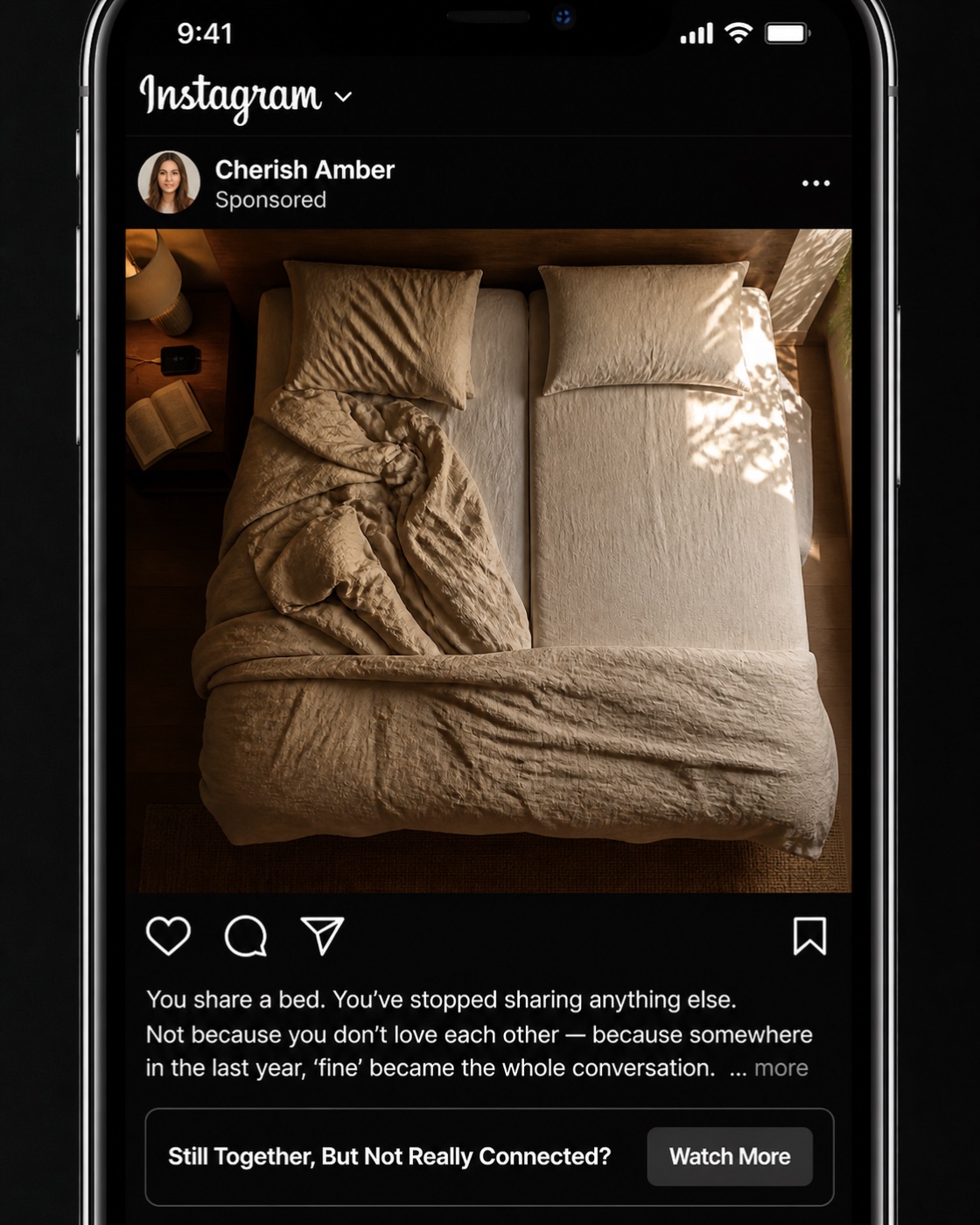
Not because you don't love each other. Because somewhere in the last year, "fine" became the whole conversation, and neither of you knows how to say what's actually true.
I'm Cherish Amber. I help couples find their way back to each other, the communication, the connection, the sex, using The 5 C's, before "fine" becomes "over."
Watch the video below. Then book a free Exploration Call if it's time to actually deal with this.

Not the "we're good" you tell your friends. The tired one. The one that's stopped expecting anything to change.
Whether you're figuring this out alone or with a partner, there's a way back to feeling wanted, heard, and touched again, and it doesn't start with fixing yourself first.
Watch this 3-minute video, then book a free Exploration Call if you want a hand.
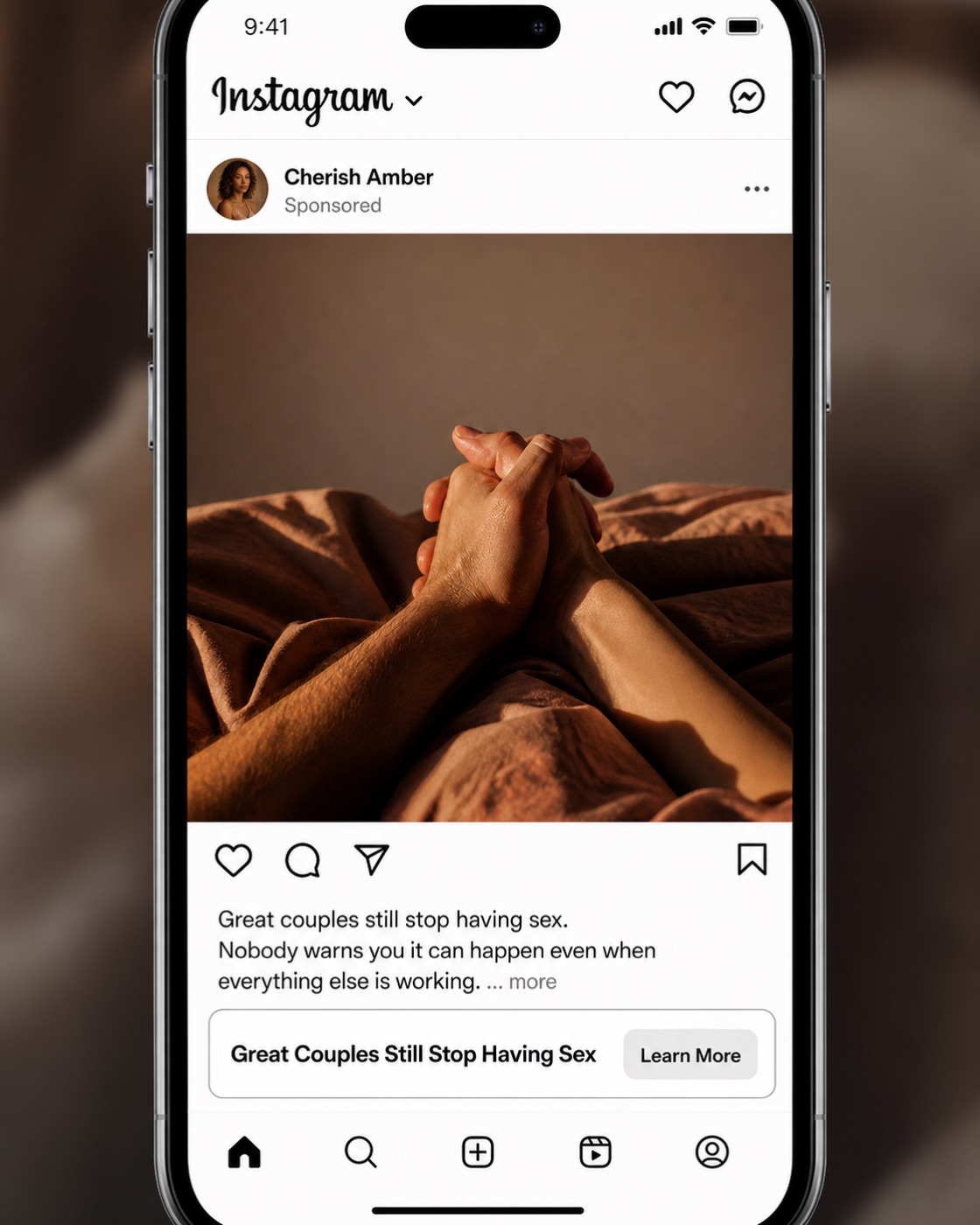
Nobody warns you it can happen even when everything else is working. It's not a sign you're broken, and more date nights won't fix it on their own.
The Pleasure Reset is exactly what it sounds like: a direct, guided way back to wanting each other again. No shame, no scripts, just a process that works.
Watch how it works below, then book your free Exploration Call.
VSL script, Concept A, full continuity
Same opening line as the ad headline. Same headline again on the landing page. 6 to 8 minutes total, and it introduces Cherish properly this time: who she is, why she's credible, before it moves into the method.
1 · Cold open, the anchor line
"You share a bed. You've stopped sharing anything else. If that's true right now, you're not broken, and you're not alone. Give me seven minutes."
2 · Turn up the pain
"It doesn't look like a crisis from the outside. It looks like scrolling next to each other in silence. It looks like sex becoming a scheduling problem, then not happening at all, then neither of you mentioning it because what's there to say. It looks like turning off the light at the same time, in the same bed, further away than you've ever been. Here's the part that actually costs you: the longer it goes on, the more it starts to feel like this is just what long-term relationships become. It isn't. It's just what happens when two people quietly stop practising being known by each other."
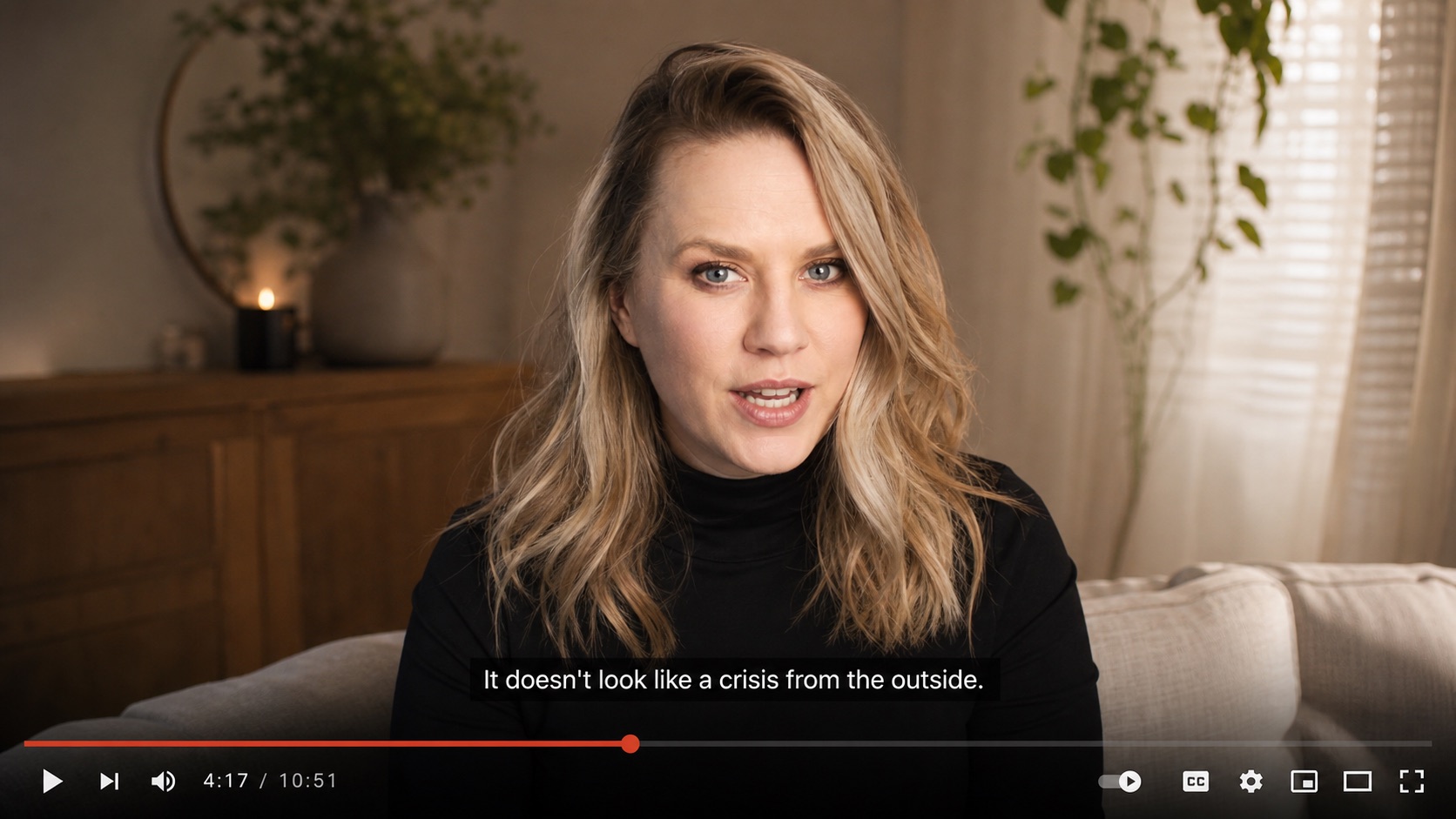
3 · Who's actually talking
"Quick introduction, in case we haven't met. I'm Cherish Amber. I'm a certified VITA coach, which means I'm trauma-informed, and I've spent my career bridging the science of relationships with the spiritual and tantric side of it, because sex is the beating heart of every great relationship, and most approaches only ever deal with half of that. I work with straight couples, queer couples, non-monogamous couples, whatever your relationship actually looks like. I'm telling you this so you know exactly who's about to walk you through this, not a script, me."
4 · Solution introduction
"Here's what working with couples in exactly this spot has taught me: you don't fix this by trying harder at the same three conversations that already aren't working. You fix it by rebuilding, in the right order, the specific skills that let two people feel safe being fully seen by each other again. That's the whole shift."
5 · Your method, The 5 C's
"That's what The 5 C's Methodology does. It walks you through strengthening communication, reigniting connection, healing whatever's underneath the distance, and finding real fulfilment, deliberately, in order, so nothing gets rushed and nothing gets skipped."
Note for Cherish: your site names 4 of the 5 C's explicitly. Slot in the 5th here once confirmed.
6 · Proof
"A couple in the US went from barely speaking to actually enjoying each other's company again. Someone in Australia finally felt safe being honest about what she needed. A couple in the UK said it changed how they show up at work, not just at home."
Anonymised, matching the tone of her real testimonials (C&K US, J Australia, E&A UK). Swap in real client language with permission.
7 · Offer overview
"How we work together depends on what's actually going on for you. Some people start 1:1. Some come as a couple. Some need the nervous-system work first, that's Inner Dance Breathwork. Some are further along and it's specifically the physical connection that's gone, that's The Pleasure Reset. We'll figure out the right starting point together, on the call."
8 · The ask
"If any part of this just described your Tuesday night, book a free Exploration Call below. Thirty minutes: I'll ask what's really going on, tell you plainly what I think would fix it, and if it's a fit, walk you through exactly how we'd work together. Direct, no fluff, and you'll know by the end of the call whether this is right for you."
30 minutes, not 60. Diagnose, recommend, close.
Cherish is genuinely good at sales, better positioned than most coaches, who usually need a script to lean on because closing doesn't come naturally. That changes the call design: it shouldn't be a long, soft, "no pressure, just a chat" diagnostic. It should be short and action-oriented, because she can close in the room once someone understands the problem.
Diagnose
What's actually going on, in their own words. Ask, then listen. Don't fix yet.
Recommend
Reflect back exactly what's going on and what would fix it. Plainly, not gently hedged.
Invite and close
Present the transformation package, not a menu of sessions. Handle the real objection, then ask for the decision. See the Setup page for exactly how the package and payment options are framed.
The jargon, decoded
Every term used from here on, in plain English, no marketing background assumed.
- Impressions
- How many times the ad gets shown on someone's screen. Not people, showings. One person might see it three times.
- CTR (click-through rate)
- Of everyone who saw the ad, the percentage who actually clicked it.
- CPM
- What it costs to show the ad 1,000 times. This is the actual thing being bought from Meta/Instagram.
- Booking rate
- Of everyone who clicked through and landed on the page, the percentage who filled in the form and booked an Exploration Call.
- Show rate
- Of everyone who booked a call, the percentage who actually turn up. Free calls get skipped more than you'd think, which is why the reminder sequence matters.
- Close rate
- Of everyone who shows up to the call, the percentage who become a paying client.
- Cost per appointment
- Total ad spend divided by calls booked. What it costs to get one person into the calendar, before knowing if they'll even show up.
- CAC (customer acquisition cost)
- Total ad spend divided by actual paying clients. What it really costs, all in, to win one client.
- LTV (lifetime value)
- How much one client is worth in total, across everything they ever pay, not just the first session. Assumed at £3,000 throughout this plan.
- LTV : CAC ratio
- How many times more a client is worth than what it cost to win them. Above roughly 3:1 is considered healthy in most businesses. See how far above that this plan sits.
If we spend £600 this month, here's exactly what happens
£600 spend, industry-standard conversion rates, month one
£600 at a £14 CPM (relationship coaching is a genuinely competitive niche on Meta; a bargain-bin £5 to £8 CPM isn't realistic here) buys roughly 42,900 impressions. At a 1.5% click-through rate, that's ~640 clicks to the landing page. If 5% of those people book a call, a realistic rate for cold traffic booking a proper diagnosis call rather than just an opt-in, that's ~32 calls booked, at a cost per appointment of about £19. If 65% show up, that's ~21 calls actually held. If 20% of those become clients, a sensible starting assumption for a first cold-to-warm call before her close rate has had time to climb with practice, that's ~4 new clients.
That's roughly £12,500 in revenue at £3,000 LTV, against £600 spent: a cost per client of about £144, and an LTV:CAC ratio around 21:1. This is the number that answers "should I spend more?", see the callout below.
Not all improvements are equal
Same £600 spend throughout, only one variable changes per row, starting from the worked example above, to show which lever actually moves the needle most.
| Scenario | What changes | Clients | CAC |
|---|---|---|---|
| Baseline | CTR 1.5% · booking 5% · show 65% · close 20% | ~4 | £144 |
| Biggest lever Sharper hook & headline | Booking rate 5% → 8% | ~7 | £90 |
| A tighter close, playing to her strength | Close rate 20% → 30% | ~6 | £96 |
| Better reminders/confirmations | Show rate 65% → 80% | ~5 | £117 |
| Just spend more | Spend £600 → £1,200 (rates unchanged) | ~8 | £144 |
Plug in real numbers as they come in
Defaults match the worked example above. Move any slider, everything downstream recalculates live, to two decimal places.